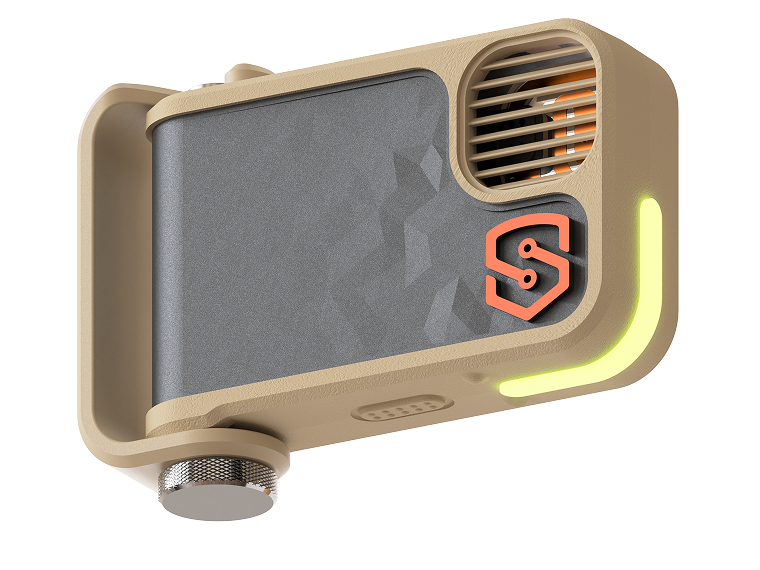
How does eWBGT work on BEACON V3?
eWBGT stands for estimated Wet Bulb Globe Temperature. SlateSafety BEACON V3s provide eWBGT alongside other environmental measurements. Using SlateSafety’s software, you can view current readings, analyze historical trends, and configure alert thresholds.
What is Wet Bulb Globe Temperature?
Wet Bulb Globe Temperature (WBGT) is an environmental heat stress index that reflects the combined effects of air temperature, humidity, air movement, and radiant heat, including sunlight.
WBGT instruments use readings from:
- Natural wet bulb thermometer: Uses a wet wick to reflect evaporative cooling, similar to how sweating helps cool the body.
- Black globe thermometer: Responds to radiant heat and the cooling effect of air movement.
- Dry bulb thermometer: Measures ambient air temperature.
The WBGT index is thus a comprehensive gauge of environmental factors influencing human heat stress.

Differences between WBGT and eWBGT
| Feature | Measured WBGT | Estimated WBGT (eWBGT) |
|---|---|---|
| How it is obtained | Calculated from thermometer readings collected by a WBGT instrument. | Calculated using environmental measurements and an estimation model. |
| Required Sensors | A dedicated WBGT instrument with wet bulb, globe thermometers, and temperature sensor. | A SlateSafety BEACON V3 that directly measures temperature across three sensors humidity, and air pressure. These measurements are then used to estimate the wet bulb and globe thermometers using selectable algorithms. |
How is eWBGT calculated?
The BEACON V3 measures environmental conditions, including air temperature across three locations and relative humidity, and provides an estimated WBGT value using the selectable algorithms. The current selectable algorithms are:
| Algorithm | Use Case | Accuracy | Inputs | Limitations |
|---|---|---|---|---|
| Liljegren | Outdoor or Indoor with Radiant Heat | 0.95°C RMSE | Air Temperature, Humidity, Wind Speed, Solar or Radiant Irradiation, Atmospheric Pressure, location, date and time. | Solar or Radiant Irradiation and Wind Speed readily available. |
| Bernard | Indoors Only | 0.47°C RMSE | Air Temperature and Humidity. | Indoor only and does not consider Solar or Radiant Irradiation. Also assumes 1m/s wind speed. |
Source: Lemke, B., & Kjellstrom, T. (2012). Calculating workplace WBGT from meteorological data: A tool for climate change assessment. Industrial Health, 50(4), 267–278. https://doi.org/10.2486/indhealth.MS1352
Because eWBGT is calculated using an estimation model, its interpretation depends on the model’s inputs and assumptions. Conditions such as direct sunlight, nearby radiant heat sources, and air movement matter when comparing an estimate with a dedicated WBGT instrument.
Why use estimated WBGT?
BEACON V3s combine environmental monitoring with connected software, making it easier to:
- Monitor multiple locations: Deploy devices throughout a facility to understand how conditions vary.
- View current conditions: Access environmental readings through SlateSafety’s software.
- Review historical trends: Analyze recorded readings over time.
- Configure alerts: Set custom thresholds and receive notifications.
- Deploy flexibly: Use wall mounts, tripods, or wearable configurations to suit the monitoring task.
For setup and mounting guidance, see How to Use BEACON V3s.